
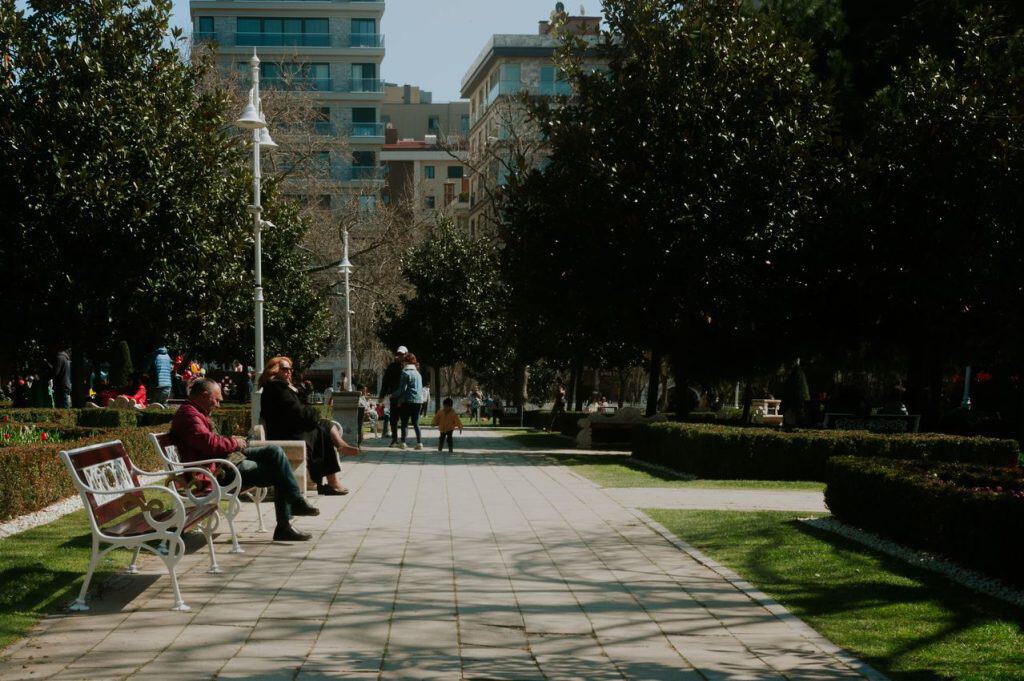
The free afternoon usually arrives unannounced. A counterpart reschedules, a site visit collapses into a phone call, and a visitor who expected to spend the day in a meeting room on Bulevar Mihajla Pupina finds three or four hours on their hands before dinner. The instinct is to open a map, notice that the fortress is barely three kilometres away, and assume the afternoon is generous. Belgrade’s geography does not quite work like that.
Start with where the meeting probably was. Most corporate Belgrade sits in Novi Beograd, on the western bank of the Sava: a municipality of numbered blocks laid out on flat ground after the war, home to roughly half a million people and to a large share of the city’s office towers. It is a serious business district and an unrewarding one on foot. The distances between buildings are long, the ground floors are lobbies and car parks, and little was built for anyone arriving on foot. Belgrade Waterfront, the newer development on the opposite bank of the Sava between Branko’s Bridge and the fairground, walks better, but it is still mostly new towers, a very large shopping mall and a promenade. Neither is where a visitor wants to spend a free afternoon.
Which means crossing a river, and the crossing is the part that costs. The old centre sits on the ridge above the right bank, and nearly everything worth the time — Kalemegdan, Knez Mihailova, Vračar — is up there. On the map it looks like nothing. In practice the traffic funnels onto a handful of Sava bridges, Branko’s and the Gazela above all, and Belgrade’s morning and late-afternoon peaks turn the approaches into long queues, where the vehicle count has grown far faster than the road network. The same few kilometres can take twenty minutes at eleven in the morning and considerably longer at half past four. Anyone working towards a hard deadline — a dinner, an airport slot — does better to treat the river as a decision rather than a detail, and either walk the pedestrian path over Branko’s Bridge, or arrange a driver on call in Belgrade in advance so the return leg is not spent on a boulevard with an app open.
What Three Hours Actually Buys
With most of an afternoon, the obvious choice is Kalemegdan. The fortress park stands at the end of Knez Mihailova, the main pedestrian street, entry to the grounds is free and they are open around the clock. The reason to go is the upper wall, where the Sava meets the Danube below and the flat expanse of Novi Beograd sits on the far side — the clearest possible explanation of why the city is laid out as it is. The Victor monument is up there, the Military Museum and the small Ružica church are inside the walls, and locals collect on the ramparts in the late afternoon. A walk through takes an hour and a half; with a museum, closer to three.
With less time, the plateau at Vračar is the better bet. The Church of Saint Sava is among the largest Orthodox churches anywhere, and its interior was only finished recently — the mosaic work, including the enormous Ascension in the central dome, was completed in 2020, and there is a crypt below. Half an hour inside is enough to see it properly. Ten minutes away on Krunska is the Nikola Tesla Museum, which is worth knowing about in advance because it cannot be improvised: visits are by guided tour only, tours begin on the hour, they run about forty-five minutes in English or Serbian, and the ticket desk takes cash in dinars. That fixed hourly start is a real constraint on a tight afternoon. It also pairs neatly with the church, which is a short walk away.
The fourth option is to do none of that. Coffee in Serbia is a unit of time rather than a drink taken standing up, and an hour at a table in a kafana or a café off Knez Mihailova, or in what remains of the older streets in Savamala below the Waterfront, tells a visitor more about the place than a rushed circuit of monuments. A driver from Belgrade Chauffeur made the point unprompted on the way in from the airport: the business passengers who ask for the fortress at five in the afternoon almost always end up asking to be dropped somewhere they can sit down instead.
Between Meetings
The realistic advice is to pick one thing and not three. Three hours, minus two river crossings at the wrong end of the day, is one destination and a coffee — not an itinerary. The visitor who accepts that will see the confluence from the fortress wall, or the dome at Vračar, or Tesla’s induction motor turning over, and will get back in time to change for dinner.
The one who tries to do all three will see the inside of a car on Branko’s Bridge, which is a view of Belgrade, but not the one worth flying in for.
The Takeaway: Keep It Simple
A free afternoon in Belgrade is enough time to see something memorable, provided the city is treated as a place with real distances and traffic rather than as a collection of points on a map. From Novi Beograd, the sensible choice is to cross once, visit one destination properly, leave time for coffee, and keep the return journey in mind.
Kalemegdan gives the clearest sense of the city’s geography; Vračar offers an easier, more compact visit; and sometimes an unhurried table in an old café is the most useful way to experience the city between meetings. The trick is not to fit more into three hours, but to make those three hours feel like they belonged to you.

About Peter C.
Peter is a digital nomad who largely writes from Asia, Europe, and South America. Always following the "vibe," he sets up shop in hostels and AirBNB's and continues to entertain us with wild stories from life abroad. Ask him anything in our community forum. Make sure to download the AllWorld Travel Hacks FREE ebook.


