Marquise engagement rings have gone from vintage curiosity to serious contender, and they’re turning up on far more hands than a few years ago. The shape is long, pointed and unapologetically dramatic. Here’s how to work out whether it suits you.
Why marquise engagement rings look bigger than they are
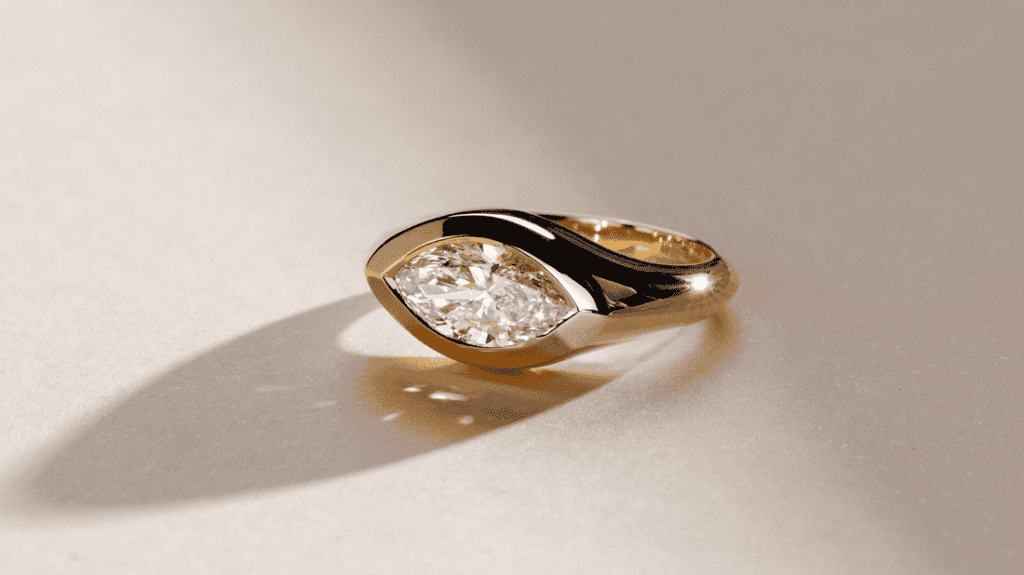
A marquise is a boat-shaped stone with a point at each end. Because so much of its weight is spread along the length rather than hidden in depth, a one-carat marquise usually shows a larger face-up surface than a round stone of the same weight. It also lengthens the finger, which is a handy trick if yours are on the shorter side. You can see that effect across the Cullen UK marquise collection, where the same stone looks quite different depending on the band and the claws around it.
The shape has a legend attached, too. Louis XV supposedly asked for a stone to echo the smile of Madame de Pompadour. Nobody can prove it, but it makes for a decent proposal story.
The bow-tie and the points
Two things trip people up with this cut. The first is the bow-tie, a darker band across the middle of the stone where light escapes rather than bouncing back. A little is normal in almost every marquise. A heavy one looks like a smudge, and you won’t spot it in a photo, so see the stone in person, ideally in daylight and under shop lighting.
The second is the tips. Those two points are the most exposed part of the ring, and a snagged knit jumper or a swinging tote strap can chip one. Good jewellers protect them with V-shaped prongs or a bezel edge. If a setting leaves the points bare, ask why.
Where the value actually sits
Round brilliants carry a premium partly because cutters lose so much of the rough crystal shaping them. Fancy shapes like the marquise waste less, so you’ll often pay less per carat for comparable quality, or get a bigger-looking stone for the same budget. Prices vary widely by clarity and colour, so treat that as a pattern rather than a promise.
If you want a more sustainable ring, this is also a good shape to pair with a lab-grown stone or recycled gold. The elongated outline suits both, and it doesn’t change the way the ring looks on the hand.
Choosing a setting that protects the stone
Setting matters more with a marquise than with almost any other shape. A classic north-south solitaire makes the most of the length. Turn it sideways in an east-west setting and it sits across the finger like a small, sleek leaf, which feels fresher and keeps the tips clear of things they might catch on. A halo adds sparkle but also bulk, and a bezel is the tough option if you work with your hands.
Band width matters as well. A slim band flatters the stone’s length, while a chunky one can make the whole ring look top-heavy. Pay attention to how the metal sits against your knuckle, because a marquise that looks perfect in a display tray can feel awkward once it’s on.
Try before you commit
Photos flatter marquise rings, and the shape rewards a real look. So do this: slip one on, hold your hand out at arm’s length, and go about your normal day for ten minutes. Type, open a door, pick up your keys. If you keep glancing down at it and smiling, and the p

About Peter C.
Peter is a digital nomad who largely writes from Asia, Europe, and South America. Always following the "vibe," he sets up shop in hostels and AirBNB's and continues to entertain us with wild stories from life abroad. Ask him anything in our community forum. Make sure to download the AllWorld Travel Hacks FREE ebook.